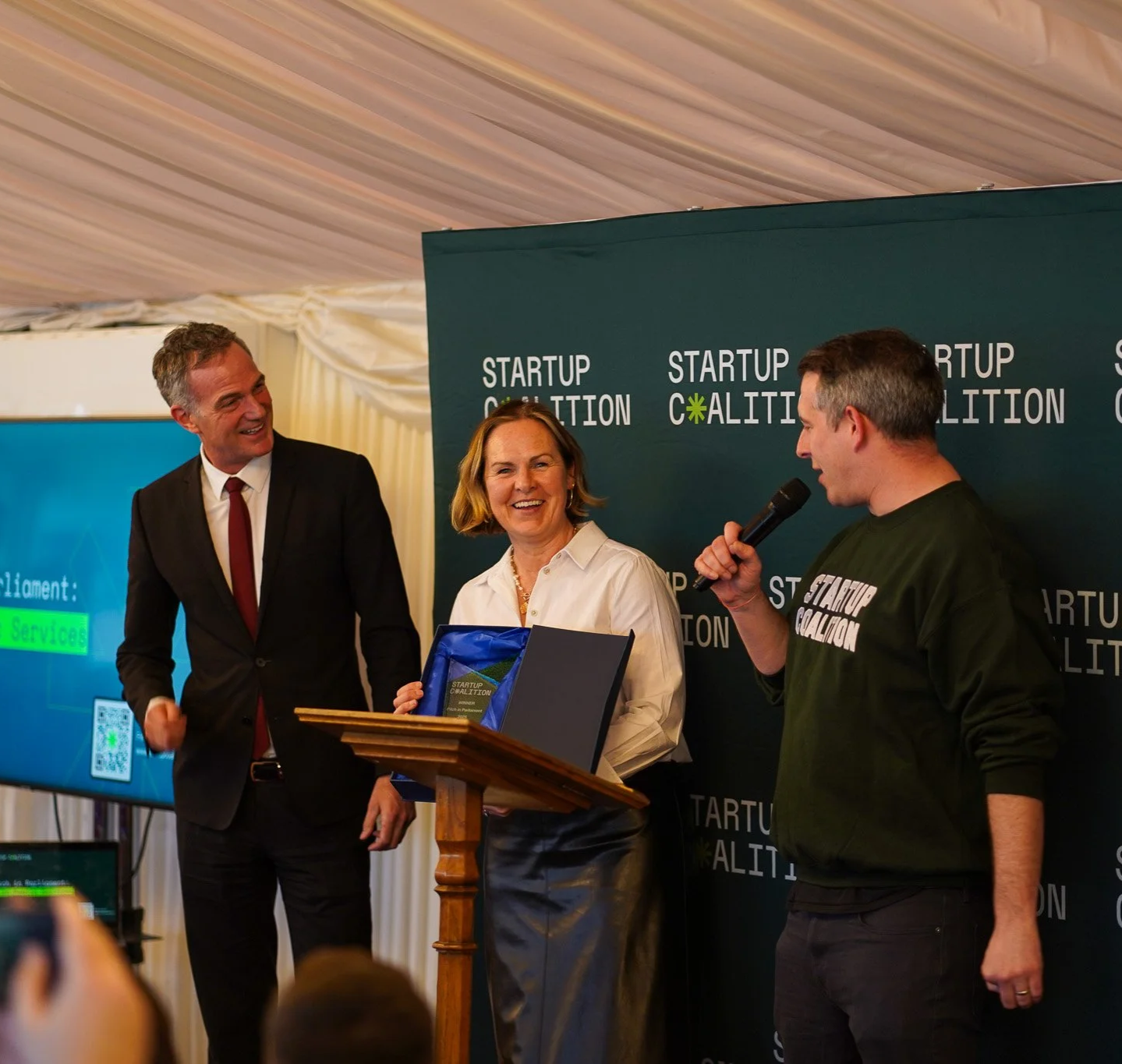
Pitch in Whitehall
The Green Compute Sprint
The Core Challenge
How can the UK public sector run next-generation AI and data intensive workloads while achieving net-zero carbon operations by 2030, reducing data vulnerabilities, and improving cloud unit economics?
The UK Government is launching a multi-billion, multi-Vendor Cloud Procurement Program. To ensure this program isn't just a vehicle for legacy technology, we are opening a Green Compute Runway for UK SMEs.
We are not looking for generic cloud hosting. We are looking for the hardware pioneers, FinOps disruptors, and GreenOps innovators who can integrate with, optimize, or compete with traditional hyperscaler infrastructure to deliver a truly sustainable UK cloud.
The Innovation Pillars: What We Are Looking For
Your solution must address one or more of the following three pillars:
Pillar 1: Hardware & Infrastructure Innovation
The Problem: AI clusters are pushing rack densities to their limits, overloading local grids and requiring millions of gallons of water for cooling.
The Ask: Liquid/immersion cooling tech, hardware-level quantum security, circular-economy server architecture, or edge-compute hardware that can repurpose waste heat locally (e.g. thermal re-use).
Pillar 2: GreenOps & Carbon Attribution
The Problem: Hyperscaler carbon dashboards can be vague or indicative, relying on offsets rather than real-time power usage effectiveness (PUE) data.
The Ask: Software that provides real-time, scope-3 carbon tracking down to the individual microservice or container level, allowing compute consumers to route workloads to the cleanest data centers dynamically.
Pillar 3: FinOps & Unit Economics
The Problem: Legacy cloud migrations may suffer from waste and inefficiency due to "always-on" over-provisioning.
The Ask: Next-generation orchestration engines that use AI to automatically right-size, spot-buy, or gracefully degrade non-critical workloads, ensuring maximum "tokens-per-watt" efficiency.
How It Works
Stage 1:
The Paperless Pitch (The "Blind" Review)
Startups submit a 5-page technical capability brief and a 2-minute video focusing purely on validated benchmarks (e.g., "We reduced LLM inference power draw by 42% in lab conditions"). No long-form procurement questionnaires required.
Stage 2:
The Den (The Live Pitch)
The Top 6 finalists will pitch live to the "Cloud Dragons" panel on the 7th September.
Senior Architecture Leads from the competing prime hyperscalers will be in the room as observers/questioners.
Stage 3:
The "Speed-Dating" & Framework Injection
The winner does not just get a trophy; they get contractual integration.
The Matchmaking: The winner is placed into a structured matching process with the primary hyper-scalers bidding for the main contracts.
The Mandate: To win in the overall procurement, the hyperscalers must demonstrate how they will utilize the challenge winner to meet the UK's Social Value Model (MAC 4.1 - Fighting Climate Change) which accounts for up to 20% of the overall bid scoring.
Who Can Apply
UK-headquartered SMEs (SMEs are suppliers that have between 10 and 250 staff and have a turnover of an amount less than or equal to £44 million or a balance sheet total of an amount less than or equal to £38 million) with a Minimum Viable Product (MVP) or commercially deployed solution at Technology Readiness Level (TRL) 6 or higher.
The Grand Prize
Direct Framework Entry: Pre-qualification onto the NCIP Cloud Procurement Program via a dedicated "SME Innovation Lot."
Guaranteed Pilot Funding: Funding to deploy a live, sandboxed proof-of-concept within 180 days of commission.
Hyperscaler Co-Selling: The opportunity for commercial partnership agreements where the selected hyperscaler acts as your distributor to the wider public sector.
Proposals will be judged on a 100-point matrix:
Environmental Impact (30%): Measurable reduction in carbon intensity, energy consumption, or water usage compared to standard hyperscaler baselines.
Commercial Viability & Scalability (30%): Can this solution handle the throughput of a major government department without bottlenecking? What are the unit economics?
Resilience & Security (20%): Does the tech enhance the UK’s digital supply chain resilience? Is it resilient against hardware-level vulnerabilities?
Integration Feasibility (20%): How easily can this be wrapped into an enterprise AWS, Azure, GCP, or Hybrid Cloud architecture?
Selection Criteria
Apply to Pitch Your Startup
Are you ready to pitch?
Apply: Submit your application by Wednesday 29th July (11:59pm).
Review: Applications will be assessed by GDS and the National Cloud Infrastructure Programme team.
Selection: The top 6 applicants will be notified in early August that they have been invited to the pitch.
Pitch: The live event takes place in person in London on 7th September.
Note: As this is an in-person event , please ensure you are available to attend in London on the 7th September if selected.